

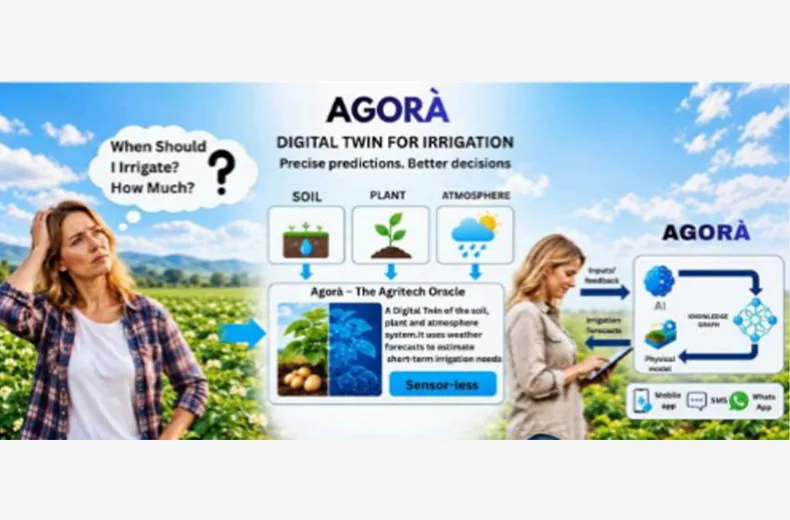
How AGORÀ combines crop, soil, weather and farm information to support irrigation timing.
Turning Field Data into Better Potato Irrigation Decisions
For potato growers, deciding when to irrigate is rarely straightforward. Rainfall can be uneven, temperatures can change quickly, and crop water demand changes throughout the growing season. A fixed irrigation calendar cannot always reflect the conditions in a specific field.
AGORÀ is VAIMEE’s irrigation decision-support system. It is designed to help growers and agronomists identify when irrigation may be needed by combining crop, soil, weather and farm-management information. Rather than following a fixed schedule, AGORÀ updates its assessment daily and can provide irrigation guidance up to three days ahead. The grower or agronomist remains responsible for the final decision.
AGORÀ can operate without permanently installed sensors in every field. Where soil sensors and on-farm weather stations are available, they can complement the advisory process. Where they are not available, the system can still use the available crop, soil and weather information to support irrigation planning.
From Operational Use in the Netherlands to a New Field Context in Italy
AGORÀ is not being assessed for the first time in commercial agriculture. For nearly four years, the AGORÀ model approach has supported irrigation advisory activities at a cooperative in the Netherlands for potato, tulip and onion production.
The 2026 assessment in Emilia-Romagna was designed to explore how this approach could be configured and assessed in a different commercial environment, with different field conditions, weather patterns and crop-management context. It therefore adds a new field case to AGORÀ’s existing operational experience.
A Commercial Potato Field Assessment
In 2026, VAIMEE assessed AGORÀ in a commercial drip-irrigated fresh-market potato field in Emilia-Romagna, Italy.
In this field, irrigation decisions were supported by soil-moisture sensor readings, weather monitoring, field observations and grower knowledge. To represent the crop and field in AGORÀ, VAIMEE used information supplied by the farm, including the sowing date, emergence date, expected crop-cycle duration and observed start of the irrigation season.
AGORÀ was also configured using soil data from field sampling, including sand, silt and clay percentages, organic matter and bulk density. Weather data were then used according to each assessment scenario.
What Was Compared – and What Was Not
The purpose of this assessment was to compare irrigation timing, not soil-moisture values.
VAIMEE did not compare soil-moisture readings from field sensors with AGORÀ’s modelled soil-moisture values. Instead, the assessment compared the dates on which AGORÀ recommended irrigation with the dates on which irrigation was actually applied in the commercial field.
The irrigation decisions made in the field were informed by soil-sensor readings, weather monitoring, field observations and grower knowledge.
The practical question was simple: could AGORÀ generate irrigation recommendations that aligned with irrigation timing in a sensor-supported commercial potato field?
Three Practical Configurations, Three Real Farm Questions
The assessment examined three AGORÀ configurations. Each reflects a situation that potato growers and advisers may recognise.
Scenario 1: Standard configuration with regional weather data
AGORÀ was run using the available crop and soil information together with local weather data. The grower-defined irrigation-season start and end dates were not provided to the model.
Scenario 2: Field-informed configuration
The same crop, soil and local weather information was used, with the observed irrigation-start date added as field-specific information. Information about the end of the irrigation period was informed by the grower’s experience and variety-related knowledge.
Scenario 3: Standard configuration with on-farm weather data
AGORÀ was run using the same standard configuration, while local weather data were replaced with data from the on-farm weather station.
These three scenarios were designed to explore how field-specific information and the choice of weather-data source can influence the timing of AGORÀ irrigation recommendations.
To explore the comparative results of the three scenarios, the irrigation recommendation dates and the modelled soil-water graphs, download the full white paper:
Download the AGORÀ Potato White Paper
Decision Support That Keeps the Grower in the Loop
AGORÀ is not intended to replace grower experience. It is designed to bring available information together in a continuously updated assessment of crop and soil-water conditions.
The system considers weather observations and forecasts, soil characteristics, crop development, modelled soil-water status and previous irrigation management. When AGORÀ indicates that irrigation may be needed, the grower or agronomist can assess that recommendation against practical operating conditions, such as water availability, irrigation capacity, labour, crop condition and harvest planning.
If irrigation is delayed, changed or not applied, that field-management feedback can be incorporated into the continuing water-balance assessment and used to inform subsequent recommendations.
The Next Step: Measuring Crop Outcomes
This assessment focused on the alignment between AGORÀ irrigation recommendation dates and irrigation events applied in one commercial field. It did not include two independent field treatments: one managed according to the standard AGORÀ irrigation strategy and another managed according to the grower’s irrigation strategy, implemented separately and at the same time.
As a result, the assessment cannot determine what effect the additional irrigation recommendations generated by the standard AGORÀ configuration would have had if they had been applied in the field. It cannot show their effect on final yield, tuber quality, the timing and uniformity of tuber initiation, tuber bulking, water-use efficiency or farm profitability.
In other words, this study did not test whether applying additional water would have produced a meaningful improvement in yield or quality, or whether any such improvement would have justified the additional water use and associated cost.
Answering these questions requires controlled commercial field trials, in which different irrigation strategies are implemented in separate treatments and crop, quality and economic outcomes are measured directly at the end of the season.

